Zambian Mining News The Premium Source of Information on The Zambian Mining Industry



Related Articles



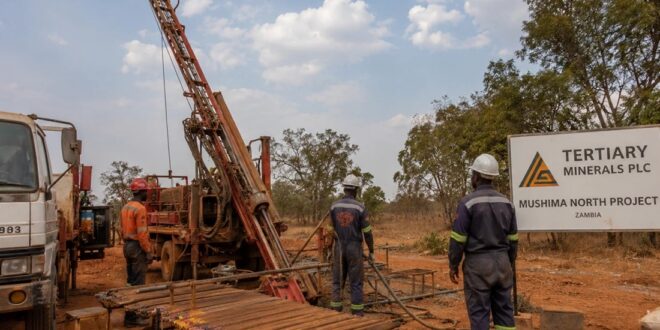
AIM listed Tertiary Minerals has released further laboratory results from its Phase 4 drilling programme at the Discovery zone within Target A1, part of the company’s Mushima North project in Zambia, building on the first batch of assay results issued on 1 September 2026.
The latest results come from an additional seven drill holes, all of which intersected near surface silver, copper and zinc mineralisation. The majority of these holes ended while still in mineralisation, extending the known depth of the system well beyond what earlier drilling had defined. Mushima North sits within Zambia’s prospective iron oxide copper gold region. Target A1 itself is a polymetallic silver, copper and zinc prospect where the company has previously outlined a near surface exploration target of between 15 million and 30 million tonnes, grading between 40 grams and 60 grams per tonne silver equivalent. The prospect lies 28 kilometres east of the historic Kalengwa copper and silver mine, which is currently being redeveloped.
According to Tertiary’s Managing Director Richard Belcher, the infill results are steadily strengthening the company’s conviction in both the scale and the grade continuity of the Discovery zone, with one intersection returning 82 metres at 53 grams per tonne silver equivalent, equal to 0.88% copper equivalent, from just 7 metres below surface. A separate higher grade zone has also been reinforced by the new data, including an intersection of 22 metres at 105 grams per tonne silver equivalent, equal to 1.75% copper equivalent, from a depth of 64 metres.
“Moreover, the majority of the holes reported here end in grade indicating the mineralisation remains open with depth and pushes the known depth of mineralisation beyond the envelope of the previously defined exploration target. The full depth extent and the possibility for the current oxide mineralisation to transition to sulphide mineralisation are yet to be tested. Additional laboratory results are expected over the coming weeks and we look forward to updating our shareholders in due course,”said Belcher. The Phase 4 programme comprised 39 reverse circulation drill holes in total. Drilling at the Discovery zone followed a series of drill lines oriented from east to west, spaced roughly 100 metres apart on a north south axis and 50 metres apart along each line, reaching vertical depths of up to 128 metres.
That depth represented the maximum the drill rig could achieve given prevailing conditions, particularly a water table higher than anticipated, which produced wet samples throughout the programme. The drilling itself was carried out in two passes, a sequencing choice that allowed the company to update its geological model as new data emerged and keep the programme responsive rather than fixed to a single plan. Further laboratory results are expected in the coming weeks, with the company set to provide additional updates to shareholders as they become available.