Zambian Mining News The Premium Source of Information on The Zambian Mining Industry



Related Articles



Kinshasa became a focal point for Africa’s mining and industrialisation agenda as government leaders, mining executives, investors and financial institutions gathered for the Makutano Mining Forum 2026, with discussions centred on how the continent can secure greater economic returns from its mineral resources.
Officially opened by Democratic Republic of the Congo (DRC) President Félix Tshisekedi on 23 November 2026, the three-day forum brought together stakeholders to examine investment, local mineral processing, domestic business participation and regional cooperation. A central theme was the need to move beyond supplying raw materials to global markets and build the industrial capacity to retain more value within African economies.
Financing featured prominently, with the DRC set to receive US$965 million in commitments directed towards its mining and wider private sectors. Of this amount, US$700 million has been earmarked for the mining industry, with financial institutions committing to support businesses across the sector’s value chain. A further US$265 million, provided through the International Finance Corporation (IFC), will support private sector development.
The funding is expected to benefit small and medium-sized enterprises (SMEs), mining subcontractors, local processing activities and trade finance. It comes amid efforts to widen domestic participation in a sector where, despite the country’s considerable mineral wealth, local ownership remains limited. Discussions on the sidelines also explored how Congolese contractors could grow into larger businesses and ultimately, become mine owners.
Setting the tone for the discussions, Tshisekedi challenged African countries to reconsider their place in global mineral supply chains. “Africa must no longer be merely the world’s mine; it must also become its workshop,” said Tshisekedi, making the case for greater industrial cooperation, particularly with neighbouring Zambia.
His argument went beyond processing capacity to the question of who controls the economic benefits generated by mineral resources. The president observed that possessing natural resources does not necessarily give a country control over the value they create, underscoring the need for domestic industries capable of transforming mineral wealth into broader economic opportunities.
He also placed traceability and responsible resource governance at the centre of the agenda, linking illicit mineral exploitation to insecurity in eastern DRC. “Every mineral that leaves our territory must be able to say where it comes from and to whom it has benefited. Traceability is not an administrative constraint: it is a tool for peace,” noted Tshisekedi.
Furthermore, he cautioned governments against competing for investment through excessive tax concessions and weakened regulatory standards, arguing that such practices risk undermining the long-term returns from resource development. His vision of mining sovereignty was rooted in the ability to translate underground resources into sustainable economic power, rather than simply increase extraction volumes.
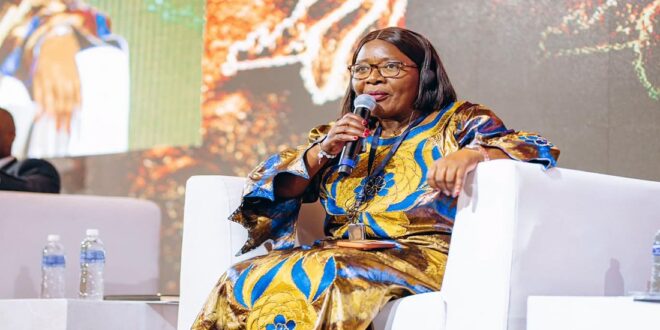
That ambition was echoed in discussions on regional cooperation, particularly the potential to develop cross-border mineral value chains and strengthen trade between African economies. Zambia’s Minister of Mines and Minerals Development, Brenda Tambatamba, called for countries to coordinate their mining and processing strategies rather than pursue them in isolation.
Speaking during a ministerial plenary on whether Africa can build its own mining value chains, Tambatamba advocated common standards in mining and processing, greater sharing of investment information and stronger regional partnerships. She also urged African countries to make fuller use of the African Continental Free Trade Area (AfCFTA) to harmonise trade policies, reduce barriers and expand intra-African trade in mineral products.
“As a country, we are cognizant of the fact that having successful local manufacturing requires attracting investments that focus on processing and value addition. This includes investing in training programmes to equip the workforce with the necessary skills and creation of partnerships and collaboration,” said Tambatamba.
The DRC and Zambia share a significant copper belt, providing a basis for regional supply chains spanning mineral processing, manufacturing, infrastructure and skills development. Greater coordination could also connect mining operations with local suppliers and manufacturers across national borders, broadening opportunities for businesses beyond the immediate mining sector.
Other sessions examined the contribution of geological intelligence, digital technologies and financial systems to strengthening Africa’s mining capabilities. Discussions included smart mining technologies and the potential for gold to support economic sovereignty and national reserves.
The DRC’s position as the world’s leading cobalt producer added weight to the debate. Although the country accounted for approximately 73% of global cobalt mine production in 2025, limited domestic refining capacity means it captures only a portion of the wider value generated by the mineral. The forum’s discussions ultimately returned to a broader question of economic legacy. As Tshisekedi put it, “The true legacy of our mines will not be the quantity of minerals we have extracted but what we have built with them.”