Zambian Mining News The Premium Source of Information on The Zambian Mining Industry



Related Articles



When Good Oils Go Bad Part 8
By Steven Lumley, technical manager, WearCheck
Continuing the dialogue around oil condition with condition monitoring specialist company, WearCheck, this time the focus turns to contamination.
In the previous instalment of this series, we saw how additives are consumed, attached to surfaces or physically removed. But many of the things that accelerate that depletion do not come from the oil at all. They arrive as uninvited guests – water, dust, soot, fuel, coolant and other foreign materials. And, like most uninvited guests, they rarely arrive quietly, behave politely or leave the place exactly as they found it.
Welcome to our final instalment of When Good Oils Go Bad, where we investigate contamination: oil’s dirty little secret.
Contamination is sometimes treated as a maintenance problem rather than a degradation mode. After all, water, dust or fuel entering a lubricant does not mean the oil molecules have degraded immediately. In practice, contaminants often trigger or accelerate the mechanisms we have already discussed: water promotes hydrolysis and oxidation, soot thickens oil, fuel dilutes viscosity and additives, and internal coolant leaks can turn healthy engine oil into an acidic sludgy crime scene.
Contamination does not simply make oil dirty. It changes how the oil behaves, protects, ages and, ultimately loses the ability to do its job. If lubricant degradation were a crime drama, contamination would not be a single suspect. It would be the entire line-up.
The Silent Accomplice: Water
Water is one of the most common and destructive lubricant contaminants, because it attacks from several directions at once. It can enter through condensation, leaking coolers or seals, wash-down practices and poor storage or handling. And once inside, it doesn’t behave in just one way- it can dissolve into the oil, remain suspended as an emulsion, or separate out as free water.
Dissolved water can be difficult to spot, because the oil may still look clear. Emulsified water, however, gives oil that familiar cloudy or milky appearance, while free water tends to settle at the bottom of reservoirs, sumps or storage containers, quietly waiting to cause trouble.
Chemically, water promotes hydrolysis (literally “water cutting”), where water breaks down susceptible base oils or additives. Ester-based fluids, some anti-wear additives and certain corrosion inhibitors are particularly susceptible. This can produce acids, sediments, sludge and additive mortality. Add heat, oxygen and catalytic wear metals like iron or copper, and water can also accelerate oxidation.
Physically, water reduces film strength and interferes with the oil’s ability to separate moving surfaces. In rolling element bearings and highly loaded contacts, this can reduce fatigue life dramatically. It also promotes rust, corrosion, foaming, aeration and poor filterability. In short, water is not just a contaminant. It is a chemical reagent, a corrosion promoter, a film-strength thief and an oxidation accelerator all rolled into one!
The Abrasive Intruder: Dust
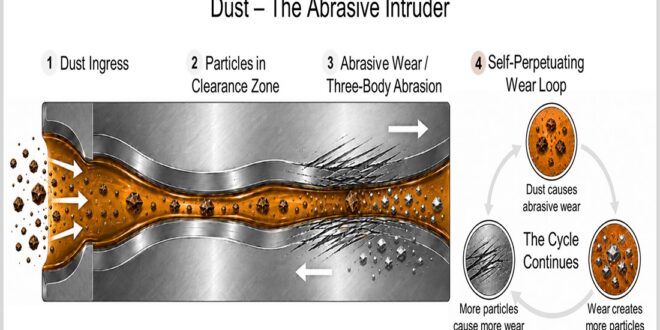
Dust has no subtlety. It enters through breathers, damaged seals, open hatches, dirty storage equipment and in engines’ leaking or poorly maintained air-intake systems. Once inside, it behaves like microscopic grinding paste.
The most damaging particles are often those similar in size to the clearances between moving surfaces. Particles much smaller than the clearance may pass through with limited damage. Particles too large may be excluded. But particles just the right size can become trapped between surfaces, disrupting the oil film and creating point loads that lead to abrasive wear.
This is where contamination becomes a vicious circle. Dust causes wear, wear generates more particles and those particles create more wear. As the concentration of fine debris and wear metals increases, the oil has to carry a heavier contaminant load. Surface-active additives can be stripped onto these particles, while metallic debris can accelerate oxidation. The result is not only mechanical damage, but faster chemical ageing of the lubricant.
The Dark Conspirator: Soot
In diesel engines, soot comes with the territory. It is a normal by-product of combustion and reaches the oil through blow-by or from deposits on cylinder walls that are scraped down into the sump. The problem begins when soot levels exceed the oil’s ability to keep them under control.
Soot particles are extremely small, but as they accumulate, they can agglomerate into larger clusters. Engine oils rely on dispersant additives to keep soot finely suspended, so it can move with the oil rather than settling out or forming deposits. When that dispersant system becomes overloaded or depleted, soot begins to behave badly.
The most obvious effect is viscosity increase. As soot-loading rises, the oil thickens, flow becomes restricted, and cold-start lubrication suffers. In severe cases, the oil may become so thick at lower temperatures that pumps struggle to circulate it effectively. If dispersancy is lost, soot can agglomerate, with degraded oil, additives and other insolubles, forming sludge-like deposits that plug filters, restrict flow and increase wear.
Soot is not just what makes engine oil black. A dark oil is not automatically a failed oil, but excessive soot can turn a lubricant into a thick, overloaded suspension that struggles to flow, cool, disperse and protect.
The Volatile Saboteur: Fuel Dilution
Fuel dilution is one of the clearest examples of a contaminant changing the physical behaviour of an oil. Diesel fuel is far thinner than engine oil, so even relatively small amounts can reduce viscosity significantly. When viscosity drops, film thickness drops with it, reducing surface separation and accelerating wear.
Fuel dilution can occur through excessive idling, cold running, poor combustion, leaking injectors, worn rings, defective fuel pumps or repeated short trips where the engine never reaches proper operating temperature.
The effect is not only physical. Fuel also dilutes the additive package, reducing the concentration of detergents, dispersants, anti-wear additives and antioxidants. Some fuel components can promote oxidation, while cylinder-wall fuel wash-down removes oil from liner surfaces and increases top-end wear. In cold conditions, diesel fuel dilution may also contribute to waxing and low-oil-pressure problems.
This is why fuel dilution is not solved simply by changing the oil. The oil analysis result is often a symptom of an underlying mechanical or operational problem. If the cause remains, the saboteur returns.
The Cool Killer: Internal Coolant Leak
Internal coolant leaks deserve their reputation. Coolant contamination can be rapid, destructive and deceptively difficult to diagnose, especially when free water is not obvious in the oil.
Coolants typically contain water, glycol and additives. When coolant enters engine oil through a failed head gasket, cooler leak, corrosion damage or liner perforation, it introduces a highly reactive cocktail into the lubricant. Glycol can increase viscosity, promote oxidation, form acids and react with additives. It can also disrupt soot dispersancy, leading to soot dump-out, sludge, deposits and filter plugging.
One of the most damaging effects is additive precipitation. Glycol can react with additives such as zinc dialkyldithiophosphate (ZDDP), reducing anti-wear and antioxidant performance while contributing to deposits and filter blockage.
Coolant contamination is a perfect example of why contaminants are not just “things in the oil.” They are chemical invaders that can change the lubricant’s viscosity, acidity, additive chemistry and deposit-forming tendency in a very short time.
The Invisible Accomplice: Air
Air deserves a mention, although microdieseling has already had its moment in the spotlight. In normal amounts, dissolved air is expected. The problem begins when air becomes entrained as bubbles, or forms stable foam.
Air increases oxygen exposure, promotes oxidation, interferes with hydraulic response, encourages foaming and reduces the oil’s ability to maintain consistent lubrication. Under rapid pressure changes, entrained bubbles can contribute to cavitation and microdieseling, where localised temperature spikes degrade the oil and form varnish, soot-like carbon, tars and sludge.
So, while air may not leave the same obvious fingerprint as water or dust, it remains a repeat offender. Invisible doesn’t mean innocent.
Detecting Contamination Through Oil Analysis
Oil analysis earns its keep by detecting contamination long before it becomes obvious in the machine. The value lies less in spotting a single, abnormal result, and more in understanding what that result is trying to tell us.
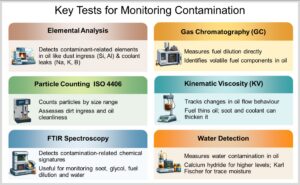
Water, dust, soot, fuel and coolant each leave their own forensic clues, from moisture readings and viscosity changes to Fourier Transform Infrared (FTIR) trends, wear metals and coolant markers. But these results should never be viewed in isolation. When it comes to contamination, the contaminant is often both evidence and accomplice – the root cause of degradation, an accelerator of another mechanism or a symptom of a mechanical fault already developing. Changing the oil may remove the evidence, but it does not always arrest the culprit.
The key tests used to assess contamination are summarised below:
Final Thought
Throughout this series, we have looked at the many ways good oils go bad: oxidation, nitration, thermal breakdown, microdieseling, electrostatic spark discharge and additive depletion. Contamination brings them all together, because it so often opens the door to additional problems.
Water accelerates chemistry. Dust accelerates wear. Soot overwhelms dispersancy. Fuel weakens viscosity. Coolant disrupts the entire formulation. Air turns pressure changes into degradation events.
The best strategy is always exclusion first: keep contaminants out through good storage and handling, breathers, seals, filtration, housekeeping and maintenance practices. Once contamination enters the oil, the lubricant is forced to fight battles it was never meant to fight indefinitely.
So perhaps contamination really is oil’s dirty little secret. Not because it is hidden from oil analysis, but because by the time it becomes obvious, it has often already invited the other degradation modes to the party.
And as every good maintenance detective knows, the earlier you catch the culprit, the better your chances of saving the machine.
Please visit www.wearcheck.co.za or contact WearCheck on marketing@wearcheck.co.za or +27 (31) 700-5460.